An update to the different cost of standards

Further to an earlier blog about the excessively high costs of standards in the UK, I note that Estonia are now selling a pdf download of EN 15804 for 17.08 euros – the BSI member rate is 7 times more than this at current exchange rates (£90) and it’s 14 times higher for non-members.

This is for the European standard, in English, providing exactly the same normative information as BS EN 15804 available from BSI.

They also, extremely helpfully, offer a “full text browsing service” for 2 euros per view.  This lets you see the whole text of the standard!

As a relatively frequent visitor to Estonia in the past, I might even suggest you use the money you save to pop over to Tallinn where the Estonian Centre for Standardisation is based to enjoy the Baltic city (though the carbon associated with this option is not to be recommended).

Posted in Uncategorized | 1 Comment

Regulation and Standards for Sustainable Construction

The Construction Products Association have provided a useful Guidance Note on the Construction Products Regulation, (CPR), available to download here.  The CPR builds on the Construction Products Directive, and explicitly contains reference to the assessment of greenhouse gases  and natural resources use over the life cycle of buildings (construction works).

For example, Basic Requirement for Construction Works 3 covering Hygiene, Health and Environment states,

“The construction works must be designed and built in such a way that they will, throughout their life cycle, not be a threat to the hygiene or health and safety of their workers, occupants or neighbours, nor have an exceedingly high impact, over their entire life cycle, on the environmental quality or on the climate, during their construction, use and demolition, in particular as a result of any of the following: …

…b) the emissions of dangerous substances, VOC, greenhouse gases or dangerous particles into indoor or outdoor air; …

and Basic Requirement for Construction Works 7 covering sustainable use of natural resources states,
“The construction works must be designed, built and demolished in such as way that the use of natural resources is sustainable and ensure the following:
  • recyclability of the construction works, their materials and parts after demolition
  • durability of the construction works
  • use of environmentally compatible raw and secondary material in the construction works.”

The CPR also states  “For the assessment of the sustainable use of resources and of the impact of construction works on the environment Environmental Product Declarations should be used when available”.  As the CEN/TC 350 standards, and in particular EN 15804, should be used as the basis of any EPD and building-level assessment used in national or European Regulation, this is highly relevant in the context of the assessment of embodied carbon and resource use for products and buildings.

For those of you who find the relationship between the Construction Products Regulation, National Regulation, TC 350 and Product Standards difficult to understand (and I often struggle with it), I recommend a link to an excellent video from Chris Hamans, the CEPMC (Association of European Construction Products Manufacturers) representative on TC 350, which sets this out clearly and makes it easy to understand – a significant achievement!

Posted in Construction Products Regulation, EPD, LCA, Life cycle assessment, Standards, TC 350 | Tagged , , , , , , , , | 1 Comment

Some interesting arctic links

A couple of links related to the arctic and its resources:

Is the arctic about to be ravaged in the search for oil and other reserves?

Britain’s richest man to build giant arctic iron ore mine

Fascinating interactive map of resource extraction in the arctic

And some other arctic links…

Arctic pollution from an arctic sea ice blog

Will ships in the arctic sea slow down to reduce whale stress?

How quickly is the oldest sea ice disappearing?

Arctic climate ‘tech fixes’ urged: cloud whitening to cool arctic ocean could work from islands

Posted in arctic, resources | Tagged | Leave a comment

a guide to understanding the embodied impacts of construction products

The Guide which I wrote with Jane Thornback is now available to download, free of charge, from the Construction Products Association website.  I hope you will find it a useful resource.

Posted in Embodied Impacts, EN 15804, Environmental Product Declarations, EPD, LCA, Life cycle assessment, TC 350 | Tagged , , , , | Leave a comment

New Update from BRE Global on TC 350

I am pleased that BRE Global have updated their November position statement on CEN/TC 350 which I discussed in my blog earlier this month, and there is some positive news to report. The update can be downloaded here and but I have highlighted some key items, and also included information from an update given by BRE Global at the most recent Construction Products Association Sustainable Construction Committee.

  • BRE Global is working on a new PCR, to include the core rules from EN 15804, which will be circulated for Peer Review in the coming months.
  • BRE clients will be able to choose if they want a BRE Environmental Profile, a new EN 15804 compliant EPD or both.
  • The new EPD programme will not be a certification scheme, but will make use of independent verifiers as used by most of the other European EPD schemes.
  • BRE Global has confirmed that it will phase out the BRE Environmental Profiles Methodology in time, but that it will need to provide Environmental Profiles and Green Guide ratings to this methodology to support the Code for Sustainable Homes and BREEAM 2011 and earlier versions which rely on these ratings.
  • BRE Global expect that IES will release the first version of IMPACT, the building level LCA and LCC tool integrated within their VE-ware suite, in Spring 2012. This version will still use LCA data from the existing BRE Environmental Profiles Methodology but future updates (no date provided) will use TC 350 compliant data when this becomes available though no date has been set.
  • BRE Global is actively collaborating in the “ECO platform”, the EeBGuide EU FP7 project, and the EOTA working party initiatives with other EPD programme operators and interested parties to try to ensure consistency in the introduction of EN 15804 EPD throughout Europe.

I have contacted BRE Global as in my view, they are not correct that weighting is not endorsed by ISO or CEN/TC 350 – both ISO 14040 and ISO 14044 include weighting as an option in LCA dependent on the goal and scope, and theTC 350 Sustainability Framework standard, EN 15643-1, covers the weighting of TC 350 indicators (as a type of valuation method) by stating that “Valuation methods, levels, classes or benchmarks may be prescribed in the requirements for environmental, social and economic performance in the client’s brief, building regulations, national standards, national codes of practice, certification schemes, etc.”

Additionally, EN 15804 only states that EPD using the core rules provided in the EN 15804 standard must contain a statement that “EPD of construction products may not be comparable if they do not comply with this standard”.  This is very different from stating that EPD produced to different EN 15804 compliant PCR documents may not be directly comparable.

Posted in Uncategorized | 1 Comment

Launch of Construction Products Association Publication

I’ve been working on a publication with Jane Thornback, ‘A Guide to the Understanding of the Embodied Impact of Construction Products’, and we will be launching it next week – details below. Date:    Tuesday 13 March 2012 Venue: Building Centre, … Continue reading

More Galleries | Tagged , , , , | 1 Comment

The different cost of European standards

With the publication of BS EN 15804 in the UK, I was surprised by how much it was going to cost to buy our UK office a copy, and having offices in Denmark and Germany too, I had a quick look to see whether other national standards bodies had published the standard in English, and how much it would cost there.  The results shocked me.

UK – BSI  £190 (member price £95) (approx 228 euro, members 114 euro)

Belgium (not yet published but price listed):  English, PDF: 64 euro

Denmark (not yet published but price listed): English. 347 DKK (approx 48 Euro)

Finland  English, downloadable: 71.83 Euros (including VAT)

Germany – was available in English from DIN for 117.40 euro, but this has been withdrawn and translation in German will be published shortly.

Netherlands  English, pdf: 70 Euro

Sweden  English, pdf: 1.055 SEK  (approx 120 euro)

BSI does a great job, but it is hard to see how the cost of a European standard, which they don’t have to translate, which has been developed by CEN working group experts, and which is provided as a download, can be justifiably so much more in the UK than in other countries.

Posted in EN 15804, TC 350 | Tagged , | Leave a comment

CEN/TC 350 and EN 15804 – what are they and why do I need to know about them?

One of the worst things about life cycle assessment (LCA) is the jargon which those that do LCA everyday understand and reel off without thinking, but which those new to the subject, including many of our customers, find bewildering.  Two new bits of jargon will be starting to make more of an appearance in the construction products arena with the publication of BS EN 15804 in the UK.  My aim here is to give you a little background to this new standard, and the work of CEN/TC 350, the European Standards committee that developed it, so that hopefully by the end, you will be a little clearer about what they are.

LCA has been used in the construction industry in the UK since the early 1990s, and by 2008, there were schemes in the UK, Austria, Denmark, Finland, France, Germany, the Netherlands and Sweden to assess the environmental impact of manufacturing construction materials. At an international level, standards had also been developed for LCA (ISO 14040 and ISO 14044) and more specifically for Type III environmental declarations (ISO 14025: 2006) which is the LCA based mechanism, more commonly known as Environmental Product Declarations (EPD) which most countries have used for these assessments.

Although these assessments of construction products all use life cycle assessment and comply with the ISO Standards, these have only been written to provide a consistent framework for the assessment, but the detailed approach of the different schemes remains highly varied. In most cases this means that manufacturers cannot make use of EPD or the underlying Life Cycle Assessment (LCA) from one scheme anywhere else in Europe.  On top of this, countries have adopted very different ways of taking this environmental data for products and evaluating it at the building level.

The mandate for CEN/TC 350 standards

CEN’s Technical Committee 350 (CEN/TC 350) was set up under a mandate given by the European Commission to CEN to “provide a method for the voluntary delivery of environmental information”  for construction. The mandate addresses the “mounting costs for industry” and “non-acceptance of environmental product information” arising from the conflicting EPD schemes in Europe, with the mandate stating that “to ensure that comparable environmental information is generated and used, without creating barriers to trade, national schemes need to be based on a common European programme founded upon European or International standards for Environmental labels and declarations – type III environmental declarations”.  The mandate also covers the  provision of a standard  that  provides  the  methodology  for  the aggregation  of  materials  data  or  data  on  components  to  provide  the  overall  integrated environmental  performance  of  a  building, whilst allowing an insight  into  the  design  of  the  building and guidance  allowing design variability.

Since the Committee started work in 2004, CEN/TC 350 has initiated the development of a suite of European Standards covering the assessment of sustainability for construction products, buildings and the wider built environment.

The CEN/TC 350 Approach

CEN/TC 350 covers sustainability by looking at the three aspects of Environmental, Social and Economic performance, and at the different levels of construction product/component, building and through framework documents which set out the approach.

The latest significant development is the publication of EN 15804, a standard providing the core rules for the production of Environmental Product Declarations (EPD) for construction products, which means the work on the environmental suite of standards is complete for now.

Going back to the original mandate, EN 15804 provides the common rules for type III environmental declarations which can be used by EPD schemes across Europe as a consistent method for providing the core environmental information on construction products which can then be used with data for other products to evaluate the building.  This new standard will ensure that comparable environmental information is generated wherever a product is manufactured or used and it is hoped that this core information can be transferred from scheme to scheme across Europe, minimising barriers to trade.

What does an EN 15804 compliant EPD look like?

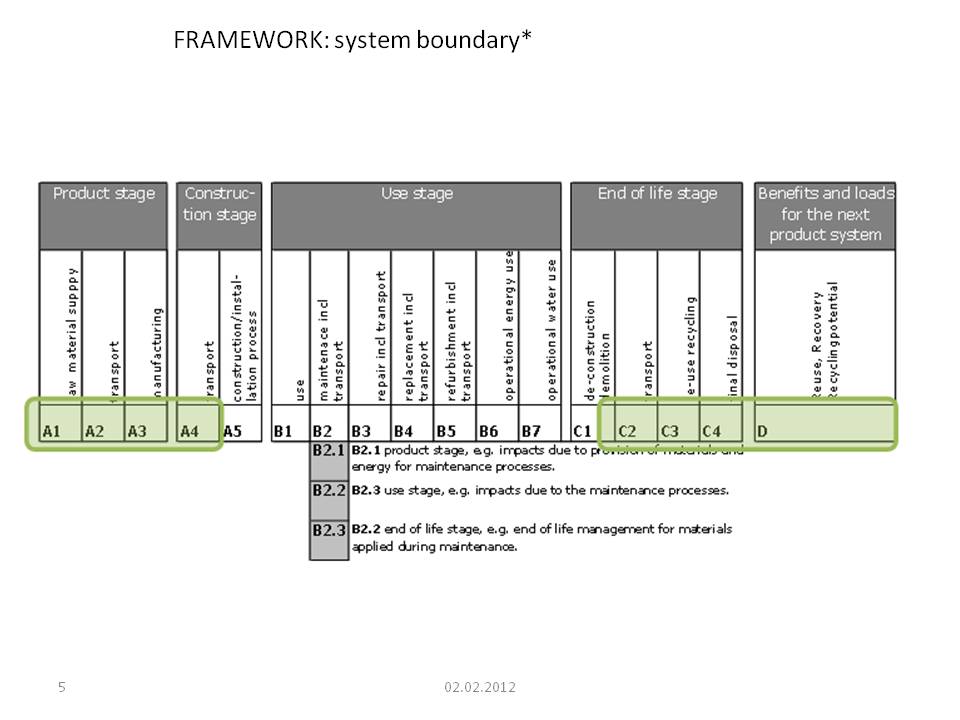
Although EN 15804 fixes the information that must be provided, it does not imply any particular layout for the EPD, so EPD from different schemes will still probably look very different from each other.  However the standard does ensures that all EPD will use the same environmental indicators, which again, currently vary between different schemes and that they will be consistently laid out in tables using the same life cycle modules as shown in Figure 1. Some examples of EPD which were produced last year to align to the standard as it was in development are for Kalzip and Gyproc.

Figure 1 ©PE INTERNATIONAL

EN 15804 compliant EPD can report performance against the indicators for 17 life cycle modules which are shown in Figure 1. The Product stage is made up of three modules, covering raw materials supply (A1), transport (A2) and manufacturing (A3), though these can be amalgamated into one stage A1-A3.  The Product stage is the only stage which it is essential to provide within an EPD, as the impact of making a product will not vary depending on where it is used. Other life cycle modules voluntary and are reported on the basis of scenarios for installation, use and disposal for particular situation within a building in a particular location – as such they are indicative because it may not be relevant for the way the product is used in other buildings or locations.

Table 1 shows the 24 environmental indicators used in EN 15804 compliant EPD.  There are seven environmental impact indicators including Global Warming Potential which is the same as Embodied Carbon measured using CO2e), ten resource indicators, quantifying the amount of resource consumed through the life cycle.  There are three waste indicators, quantifying the amount of waste produced through the life cycle and 4 output flow indicators, showing the amount of material leaving the system boundary which will be used in another product system, through reuse, recycling or recovery.

Table 1: The 24 Environmental Indicators used in TC 350 standards

Environmental Impact Indicators
  • Global Warming Potential (GWP)
  • Ozone Depletion Potential (ODP)
  • Acidification potential (AP)
  • Eutrophication potential (EP)
  • Formation potential of tropospheric ozone (POCP)
  • Abiotic depletion potential for non fossil resources (ADP-elements)
  • Abiotic depletion potential for fossil resources (ADP-fossil fuels)
Resource Use Indicators

  • Use of renewable primary energy excluding renewable primary energy resources used as raw materials
  • Use of renewable primary energy resources used as raw materials
  • Total use of renewable primary energy resources (primary energy and primary energy resources used as raw materials)
  • Use of non renewable primary energy excluding non renewable primary energy resources used as raw materials
  • Use of non renewable primary energy resources used as raw materials
  • Total use of non renewable primary energy resources (primary energy and primary energy resources used as raw materials)
  • Use of secondary material
  • Use of renewable secondary fuels
  • Use of non renewable secondary fuels
  • Use of net fresh water
Waste Category Indicators

  • Hazardous waste disposed
  • Non hazardous waste disposed
  • Radioactive waste disposed
Output Flow Indicators

  • Components for re-use
  • Materials for recycling
  • Materials for energy recovery
  • Exported energy

What does the new TC 350 standard mean for construction?

With the publication of EN 15804, and the completion of the current suite of environmental standards from TC 350, manufacturers should be able to undertake a single EPD study for their product manufacture which can be used across Europe.  Already, EPD schemes in Germany and Sweden have consulted on a revision of their scheme rules to align with EN 15804 and EPD which fully comply with the standards should be produced in the coming months.  The recently published NEN EN 15804 in the Netherlands has superseded their national standard, NEN 8006: 2004 which has been used as the basis for Dutch construction product LCA, and this is expected to be the case in France for NF P01-010:2004 used as the basis for Fiches de Déclaration Environnementales et Sanitaires (Environment and Health Declaration Sheet – FDES) listed in inies when EN 15804 is published there.

In parallel, the Calculation Methods Standard, EN 15978, provides the rules to evaluating and reporting the whole life impact of a building over its lifetime. The IGT final report published in 2010 stated that “CEN-TC350, which will become available over the next two years, should be the basis of measuring CO2e in products and projects”. So now that these standards are finally available, we should be able to move to a consistent method of measuring and reporting embodied impact and embodied carbon across the industry.  In addition, with the adoption of the standards within Europe, the availability of compatible environmental data for construction products evaluated to the same standard should become very much wider.

Posted in EN 15804, Environmental Product Declarations, EPD, LCA, Life cycle assessment, TC 350 | Tagged , , , , | 1 Comment

An overview of BRE Global’s Response to CEN/TC 350, and some questions…

BRE Global has recently published their approach to the new standard developed by CEN/TC 350, EN 15804, which sets overarching Product Category Rules for EPD. The full document was originally circulated to the Construction Products Association Sustainable Construction Committee in November 2011 and a shorter statement is also available.

BRE Global have undertaken a comparison of the methodologies for life cycle assessment of construction products provided in EN 15804 (to be published through BSI later this month) and the 2007 update of the BRE Environmental Profiles Methodology. This comparison is not available in the public domain however and the basis of the comparison (ie materials studied, weightings used, treatment of recycling beyond the system boundary (Module D) is unknown). The study apparently included a comparison of the environmental performance for a wide range of construction materials using both methodologies, which showed that “whilst the absolute results may differ, the relative performance remains the same”.

BRE Global states that “there is enough overlap in the environmental, resource use and waste parameters measured by the two approaches to ensure that the BRE Global method meets the requirements of TC 350”. Following on from this, and as a result of the finding that the relative performance of products remains the same, BRE Global have decided to continue to use the existing Green Guide Online, based on the Environmental Profiles Methodology in BREEAM, but to provide EPD in the future to both the Environmental Profiles and EN 15804 Methodologies.

I am afraid I have to disagree with BRE – there are too many differences from TC 350 for me to consider that the BRE Global method meets the requirements of TC 350.

How much difference is there between the BRE Global method and TC 350?

The table below highlights the key differences between the two methods, some of which could have significant difference for particular materials.

Environmental Profiles CEN/TC 350 EN 15804
Methodology
System Boundary Point where the next system starts to pay for waste, by-products, co-products or recycled material Point at which the waste reaches the “end of waste” state (based on Waste Framework Directive). For outputs which are never waste system boundary occurs at point of production.
Allocation to End of Life Recycling Yes, by value, based on value of scrap arising after demolition and value of “basic material”, eg aluminium ingot, steel slab. No. But benefits of recycling beyond the system boundary can be shown in “Module D” and may be included in building level assessments
Replacement Factor calculation Service life used to provide probabilistic replacement factor (ie 30 year service life would mean 100% of product replaced by year 45, 150% replaced by year 60 and 200% replacement by year 75.)Methodology assumes 60 year study period but demolition can occur any time after. Service life used to provide deterministic number of replacements – eg a service life of 30 years will mean complete replacement in year 30 and year 60. EN 15978 allows for replacements close to the end of the building life to be omitted if they wouldn’t happen in reality.Study period based on building life required by client or regulation, and demolition happens at the end of the study period.
Indicators
Toxicity (human , ecotoxicity to fresh water and to land ) Included (25.4% of Ecopoints weighting) Not included
Minerals extraction Included – total mass of minerals extracted (9.8% of Ecopoints Weighting) Not included
Abiotic Depletion Elements Not included Included – measure of scarcity of chemical elements such as metals
Nuclear Waste Volume of intermediate and high level nuclear waste measured (8.2% of Ecopoints weighting) Total mass of low, intermediate and high level nuclear waste measured (low level waste is majority of overall nuclear waste)
Use of renewable primary energy Indicator not included Included (split into feedstock and energy use)
Use of non-renewable primary energy Fossil Fuel use included (3.3% of Ecopoints weighting) All non-renewable primary energy use considered (includes nuclear energy)
Use of secondary materials and fuels Indicators not included Indicators included.

Would the relative performance of materials really not change if the TC 350 methodology was used?

Without access to the BRE materials database or sight of the research, it is impossible to be certain of this, but in my view, it is unlikely for the following reasons:

  • The BRE indicators not included within EN 15804 account for at least 35% of the weighting in Ecopoints and are significant contributors to overall ecopoints for many materials. BRE have also not provided any indication of how they have weighted the EN 15804 indicators which were not used by BRE, such as abiotic depletion or use of renewable energy.
  • Although the BRE Minerals extraction category and the EN 15804 Abiotic Depletion Elements category both relate to resource depletion, they are highlighting very different issues. The BRE Minerals extraction impact relates to the total mass of material extracted from the environment, whereas the Abiotic Depletion Elements category relates to the scarcity of chemical elements within the earth’s crust, and the rate of depletion.
  • Additionally, there are significant methodological differences in terms of system boundary, allocation to end of life recycling and replacement factor calculation that vary between the two systems, and BRE has not stated if or how they have been considered.
  • For treatment at the end of life, there will be significant differences for the EN 15804 methodology depending on how BRE consider the benefits beyond the system boundary shown in Module D – again we don’t know how BRE have considered this.

BRE Global states that “there is enough overlap in the environmental, resource use and waste parameters measured by the two approaches to ensure that the BRE Global method meets the requirements of TC 350”. Does the approach used in Environmental Profiles, the Green Guide and BREEAM meet the requirements of TC 350?

  • In my opinion, it does not, for the following reasons:
    • Environmental Profiles and the Green Guide are not based on a CEN/TC 350 compliant methodology, as shown by the significant differences highlighted above. Without publication of the analysis which underlies BRE’s claim that “the relative performance remains the same” it is difficult to take this at face value.
    • Green Guide ratings are based on typical specifications. At present, if the specification listed in the Green Guide matches the one used in the building in terms of materials, then the Green Guide rating can be used. This does not take into consideration differences in thicknesses or spacing of materials, exposure of the actual building and the effect this might have on service life, or real site waste management or transport strategies.
    • BREEAM currently uses the midpoint ecopoints score for each Green Guide rating together with the area of elements to calculate the overall building impact, and hence the amount of credit. The CEN/TC 350 approach is intended to provide a full building life cycle assessment, taking account of the actual specifications and materials used, including building structure, foundations and building services. As BRE state, Green Guide is a useful guide to the relative impact of constructions, but it not a mechanism to provide building level LCA as required by CEN/TC 350.
    • Because BREEAM credits are not provided for the foundations, core building structure and building services, a significant proportion of the building impact is not being considered.
    • CEN/TC 350 also requires that the effect of construction products at the building level is taken into consideration. Again, because of the elemental nature of the Green Guide assessment, the effect of heavier cladding and floor decks on the structure and foundations or the embodied impact of different types of building services equipment cannot be assessed or considered within Green Guide and hence a significant aspect of CEN/TC 350 is ignored.

What about the barriers to trade CEN/TC 350 was supposed to remove?

    • The CEN/TC 350 standards were mandated by the European Commission to remove the barriers to trade that have existed for manufacturers whilst countries use their own incompatible national EPD schemes. By continuing to use the Green Guide to assess materials, BRE Global are maintaining a considerable barrier to those with EN 15804 compliant EPD from outside the UK, in terms of competing on the basis of their product’s actual life cycle environmental performance. For those working with the Environmental Profiles scheme, costs will be increased because they will need to produce EPD to the two methodologies.

Conclusion

By maintaining the use of the Environmental Profiles Methodology and the Green Guide based on it, BRE Global continue to operate independently of other European EPD schemes which are fully adopting TC 350, and they are providing a barrier to trade for European producers with other EPD who cannot use these directly within BREEAM. For producers using BRE Global to produce EPD, costs will be increased as two separate EPD and LCA models will need to be produced to take account of the two different Methodologies.

Whole building LCA, based on TC 350 is the mechanism which we should be using to ensure that we are correctly addressing the reduction of environmental impact from buildings which is required – this is the only approach which will ensure operation and embodied impacts are balanced, and that the complex interplay of different construction choices are considered in the whole. Unfortunately, the BRE Global approach does not currently meet this objective.

Posted in BRE Global, EN 15804, Environmental Product Declarations, Environmental Profiles, EPD, Green Guide, LCA, Life cycle assessment, TC 350 | Tagged , , , , | 4 Comments

Falling applications for architecture courses – I wonder why?

UKAS Architecture applications fall by 17.2% http://www.architectsjournal.co.uk/8624463.article

Higher graduate unemployment rate (9.5% compared to 8.5% generally) http://b4ed.com/TN_99_Build_Engineer_Graduate_Employment.html

Unemployment generally – 1030 architects unemployed http://www.building.co.uk/architects%E2%80%99-unemployment-rate-falls-by-16-in-a-year/5028097.article

University debt – 67% of architecture students say they are experience ‘basic financial hardship’.  http://www.architecture.com/Files/RIBAProfessionalServices/Education/CareersInArchitecture/StudentFinancesSurvey2011.pdf

Professional Pay – £38.4 median Full time salary http://www-958.ibm.com/software/data/cognos/manyeyes/visualizations/full-time-salaries-men-and-women-c  and http://www.guardian.co.uk/news/datablog/2009/nov/12/pay-salaries-survey-ashe-ons

but thankfully they are the sexiest professionals! http://www.worldarchitecturenews.com/index.php?fuseaction=wanappln.projectview&upload_id=14307

Posted in Uncategorized | Leave a comment